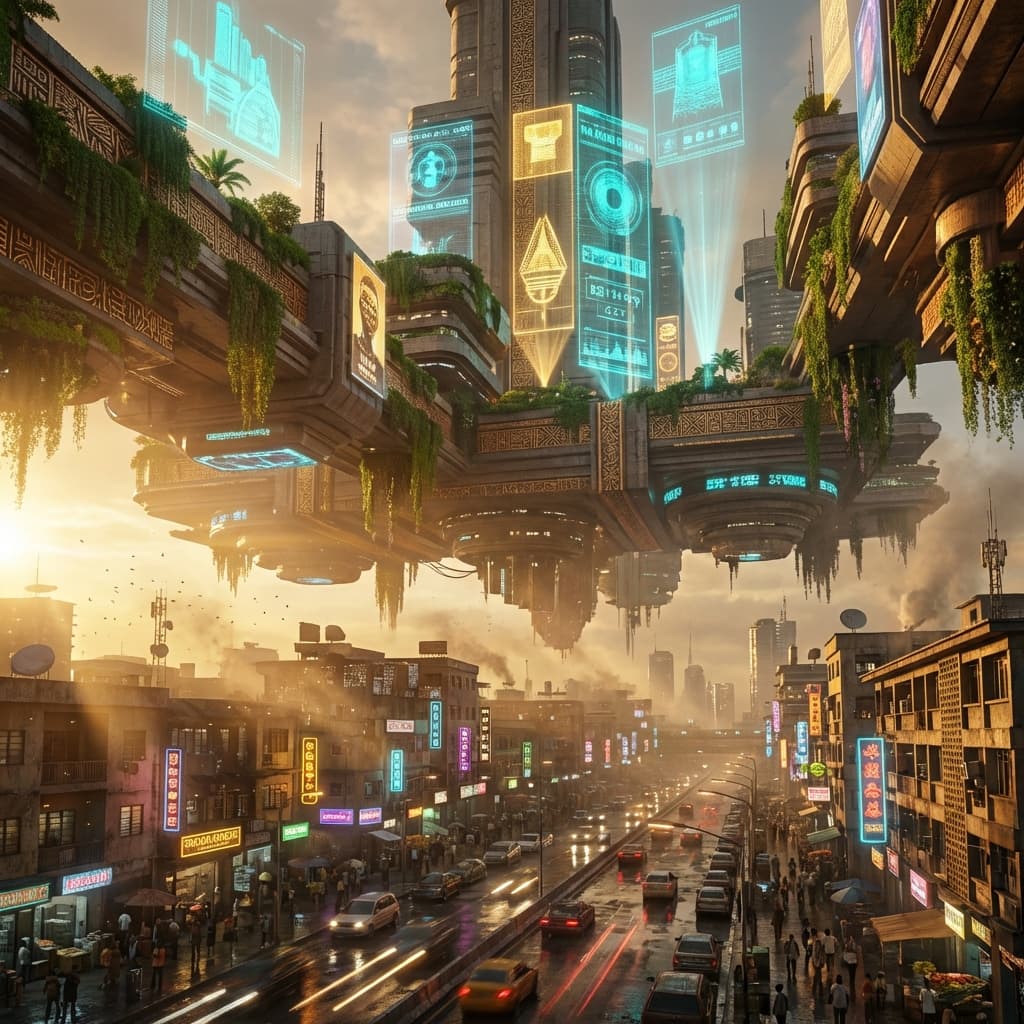
Walking the Ajegunle seam, Afolabi named the things the city would forget by morning. The cracked patch on the plaza's holo-screen, where Commander Oluchi's six-petalled glyphs blazed on loop above an Ajogun breach sealed in Abuja. The empty stall down the row, dark for a week now. His own face, narrow at the temples, his mother's mouth. And the name of the woman who had sold groundnuts at that stall. A name that had been on his tongue every Friday for two years and now would not come. The vendor next door had stopped using it when he asked her what it was.
He named them under his breath, ran them like beads through his teeth. It was the only ritual he had kept since the year his mother was taken.
Lagos opened its throat and swallowed the names.
He kept making them.
Past the holo-screen, children mimicked Oluchi's stance, jabbing sticks they pretended were conduits of divine fire. The news ticker scrolled beneath her: Three rifts detected across Lagos. Ministry of Divine Affairs response teams deployed. MoDA, the watchers, the agency that catalogued every flicker of divine power in the city. Three wounds. The city had a body, and the body was bleeding. The number felt significant, though Afolabi could not say why.
Neo-Ajegunle shimmered in the heat. Solar cloths sagged between market stalls, poles humming with weary blue charge. Vendors shouted, voices tangled with crackling speakers nailed to rusting beams. Somewhere, a hymn and a sales pitch blurred into one note. Ajegunle was a body that did not know how to be quiet, and Afolabi loved it for that.
At seventeen, he was older than most Disciples when they first awakened, old enough that the hopeful glances had turned to pity, old enough to accept the truth whispered in market corners: some children simply carried no spark. Let them pity him. Let them whisper poor boy, no spark. He had learnt the trick of survival in Lagos instead. Be no one. Be smoke. The city forgot smoke by morning, and a boy the city forgot was a boy nothing came hunting for. The names were the part he could not stop.
Afolabi slowed, not from tired legs but from a faint pulse pressing against his chest.
He touched his shirt where the mask lay hidden, cool wood warmed by skin. For ten years it had been only weight. Dead wood on a cord. Dead wood that had cost him a mother.
Now, faint as a heartbeat underwater, it stirred.
He stopped walking. His hand pressed flat against his sternum, feeling for the pulse again. There. Soft but unmistakable. After ten years of absolute nothing, the pendant was awake. The wood remembered first; he would have to catch up.
His throat tightened. Ten years of teaching himself not to hope, and the wood was choosing this hour, this market, this boy to wake against.
And memory came, the way it came when his fingers found the wood and held it. Not the lullaby. The other thing she had given him, the one she made him repeat until the words sat in his mouth like his own teeth.
She had taught him on the last night. He understood that now, though at six he had only understood that her hands were shaking and her breath smelled of fear. She had pulled him into the dark behind the curtain. She had set the pendant against his chest until the wood and his heart beat against the same rib. She had said the lines fast, faster, again, again, as if she were braiding him a rope that had to hold.
Say who you are, she had told him. Before the world tells you. Before it forgets.
And he had said it. The line of his name. The praise of his people. The small fierce poem she had built for him out of river and fire and the names of the dead who had made him. He had been six. He had thought it a game they played in the dark.
She had not finished teaching it. There was a last line, the one that named what he would become, and the night the light took her she had been speaking it, the word broken in her mouth, then the mouth taken. Ten years, and he still did not know how his own name ended.
"Not tonight," he muttered, forcing his feet forwards.
A radio tried a highlife riff, faltered, slid back to static. Heat clung to the air like a promise unbroken. In the scents of pepper, smoke, and sweat, he found a question, a call matching the unfinished name in his mouth.
Afolabi walked the seam where the market met the wall. He liked that thin place, where the city asked nothing of him. His fingers found the pendant under his shirt. A small wooden mask on a cord, its grain rubbed smooth by years of skin. Shallow eyes. A carved mouth. If he leant in, he could still smell palm and old smoke in the wood.
Once, it had burnt him. Ten years ago. His mother's mouth had shaped a word that never finished. Then she lowered the pendant's cord over his head and pushed him toward the door. Smoke came through the room. The pendant answered with light as the thing took her. It had seared his palm that night, clutched in both small hands, the first and last time it showed any life at all. The years since had been ordinary on purpose.
Makoko was meant to keep him safe. Aunty Ronke and Uncle Duro had made a home for him and the twins there. Solar shutters. Quiet water lanes. Meals that never ran out. But it was a soft thing, without bite or ache. He chose Ajegunle instead, where streets shouted and remembered. Where silence had to be earned, and Afolabi knew the price.
"Guy, you dey hear me? Abi Ajogun don chop your ear?" Taiwo's voice cracked through the bead-com tucked at his collar.
Afolabi smiled, grateful for the distraction. "Static dey sweet pass your talk, jare."
"Na lie. My voice sweet pass."
He burst out laughing before he could stop himself. Unlike him, the twins had awakened at fourteen, side by side the way they had done everything since the womb. Kehinde could read the emotional resonance of objects; Taiwo bent metal with his mind. The Lagos Cohort's junior division had recruited them both, and they spent their days training in the floating academies above Victoria Island.
They came home to him without being asked; they had been his family before they were the Cohort's. Of everyone in Lagos, only the twins still said his name out loud. The city was learning to forget him; they were not.
A vendor shouted, "Pepper soup, sweet and hot!" Somebody yelled back, "Too hot, abeg!" For a second, the noise of the street felt almost kind. Then it thinned, the signal scratching, breaking into static, and the market went back to forgetting him.
He tested a drainage rail for balance, then dropped. A boy's trick, proof his body was still his own.
A MoDA drone drifted above the lane, the white triangle of its registry stamped under a lens that swept like a tired eye. Light rolled across baskets, yams, walls, then stopped on him. It clicked. The click held his chest like it had found something it did not trust.
The pendant flared against his skin. Not the gentle pulse from before. Fire, bone-deep heat that punched the breath out of him, the wood searing into his sternum like a second heartbeat overriding his first.
Ten years of nothing. And it woke now, not at random, but the instant the drone's lens found him, his light and its gaze closing a circuit.
His hands shook as he lifted the hem. The mask glowed along its carved seam. Gold shifted towards blue. Not dazzling, but pure. A thin scent rose, sharp resin, the crisp edge of something burning without smoke.
"O boy, see as light dey shake," someone muttered in the crowd.
ANOMALY: CLASS UNKNOWN. UNREGISTERED LIGHT. PENALTY PENDING.
The beam faltered. The drone veered, lost its grip, drifted away like a stronger hand had pulled it aside. Lagos was looking at him now, and pretending it was not.
Afolabi tucked the shirt and gripped the cord. One pull could free it. He tried. Heat bit his fingers, clean and merciless, like a nail hammered into bone.
He let it fall. Breathe out. Breathe in.
"If I drop you, I drop her," he whispered.
The pendant cooled enough to breathe around. He touched the bead-com with trembling fingers. "Taiwo."
Static.
"Kehinde." She could read objects, see their history. Maybe she could tell him what this meant.
Only white noise answered. The line that kept his name in the world had gone silent. His hand curled into a fist. He was the only mouth left that knew his name, and the night was coming for it.
A shadow flickered at the edge of his vision. It had no source he could find. The light around it moved one way; the shadow moved another. It stood in the corner where two walls met, still as stone, waiting for him to notice.
He noticed.
The market thinned around him. Voices pulled back. The vendor two stalls over turned to restock, her back suddenly to him. A child ran past without looking up. Even the MoDA drone had drifted into another lane. The street was forgetting he was there, the way it always did, and for the first time in his life the forgetting did not feel like safety.
The corner remained. It held its shape the way a mouth holds a word before speaking.
Afolabi took a step back. The pendant warmed against his ribs, a low pulse that matched his heartbeat.
The shadow moved. It did not walk. It folded through the space between vendor stalls, slipping through gaps too narrow for substance. Where it passed, colours dimmed. Sounds flattened. A hanging solar cloth sagged like weight had pressed it down, though nothing touched it.
He ran.
Not away, he had learnt that much from the streets. Running from a thing gave it permission to chase. He ran towards the places he knew, the alleys with two exits, the rooftops with safe landings.
His shoes found purchase on a stack of crates. He climbed. The market sprawled below, a maze of tin and voices. Above, the sky held its evening colour, deep and cloudless.
The shadow followed. It rose through the wall beside him, seeping up through brick like water through cloth. Silent. Effortless. Only presence, and the certainty of arrival.
He made the rooftops with burning lungs and a stitch in his side that would not ease. Neo-Ajegunle's skyline opened beneath him, a patchwork of corrugated metal and solar panel, the bridges between buildings like stitches in the city's hide.
Behind him, the shadow climbed.
He could see it now, properly. Something shaped like a person, but the shape would not hold. It held the idea of a figure. Shoulders, head, reaching arms, but the details refused to settle. Like looking at something through water, then through smoke, then through nothing at all.
The bridge appeared ahead, an old maintenance catwalk connecting two buildings. Rusted steel and missing bolts. Afolabi had crossed it a hundred times, knew which planks held weight and which ones sang warnings. He stepped onto it without slowing.
The metal groaned, a vibration through his soles that said not much longer. The opposite roof waited, close enough. He would make it.
The shadow arrived at the bridge's edge.
It stopped. For the first time it hesitated, its formless edges pulling back, testing the threshold where rooftop became bridge, solid ground became empty air.
Afolabi reached the centre of the span and turned.
They faced each other across fifteen feet of rusted steel. The pendant ran so hot he could smell singed cotton, his vision fraying where heat haze met exhaustion.
The shadow did not breathe. It sampled. He felt it read the air around him the way the MoDA drones read it, sweeping, cataloguing, except this thing measured something the drones had no sensor for. And as it read him, he understood it back.
It was not a hunter of bodies. It was a hunter of the unremembered. It took what the city let slip, the names no one spoke, the boys who learnt to be smoke and slipped through gaps unnoticed. It had found him because he had made himself exactly that. No one. Forgettable. A boy Lagos would forget by morning.
He had spent ten years building the very thing that was about to swallow him.
"Not today," Afolabi said, and did not believe it.
The shadow listened. He felt it in the air, a pressure that had not been there before. It understood him. Knew him. Had been sent for him.
A coin sound began. Soft at first, like someone tapping metal against stone. Then louder. Then everywhere at once, a rain of invisible coins falling through air that held nothing to catch them. The sound came from the air itself, from the shadow, from the space between what was and what wanted to be.
He backed to the span's far end, where the bridge had torn from its moorings months ago. Behind him, nothing. The torn steel bit into his shoes. Air moved through the gap below like a throat learning how to breathe, and he kept his feet still, because there were no more places left to put them.
He could jump. The opposite roof waited a body length too far for a living boy. He could drop the pendant, let it fall into the dark, and maybe the thing that hunted what his mother left him would chase the wood instead. Drop her. Drop the last of her.
He would not.
His vision flickered. For an instant he was six years old again, the pendant warm between her hands, her voice low in the dark. Say who you are. Before the world tells you. Before it forgets.
He understood, then, what she had been arming him with: a weapon made for exactly this. The Echo took the nameless. It could not hold a boy who named himself.
And he understood the cost. To be smoke was to be hunted by this. To speak his name aloud, here, under MoDA's lenses, with the drones drinking every word, was to stop being smoke forever. To be seen. Catalogued. Hunted by everything else, by the watchers and the hunters and whatever wore Commander Oluchi's six-petalled glyphs, for the rest of his life.
Ten years of safety, or the next ten seconds.
"Edge or nothing," he whispered.
He chose.
"I am Afolabi." He said it to the shadow first, low. Then he lifted his chin and said it to the drones, to the city, loud enough that the rooftops took it. "Son of Yétúndé, who walked back through death to carry me. Child of the river that does not forget its road. Child of the fire that sleeps in carved wood. The smoke could not keep me. The city will not forget me. Teach it to remember."
The coin storm faltered.
The Echo recoiled, its edges fraying like smoke in wind, because there was nothing nameless left to take. He was named now. He was loud. He was, for the first time in ten years, impossible to forget.
The pendant answered the way a key answers a lock. Light burst from beneath his shirt, gold bleeding into violet, bright enough to cast shadows on the rooftops below. A drone scanned the light and its lens burst, raining glass over the alley. But in the heartbeat before its quantum core failed, it had already transmitted. Afolabi's face. His voice. The anomaly's full signature. MoDA's archive received the packet and classified him in real time: Class A. Unregistered. Active. By dawn, every drone in West Africa would carry his face in its priority feed. The hunt protocol had opened. Another drone came apart in the strange air before it reached the ground.
A crack sounded where there was no wood to split. The sky between buildings wrinkled. A star showed in full evening light, too bright to be a planet and set where no constellation had any right to be. A thin tear ran from that point to a second, and from there to a third, so clean and slow it made his teeth hurt to watch it.
People screamed. The market below found its voice too late and all at once. "Make una run o!" Pots hit stone. A child cried and would not stop.
Ẹ má bínú, Ọlọ́run, someone sobbed from a window. God, don't be angry with us.
The sky did not open in a single motion. It parted like cloth mended too often, threads loosening one after another. Gold spilt down as dust. Violet ran between the gold like water, finding a crack. The tear lifted itself wider until a shape hung there, somewhere between a door and a mouth, and no street had a word for it. In its depths the city hung upside down, shimmering like a reflection caught on glass. Lagos turned like a coin in someone's hand.
A hand brushed through his thoughts. Memory, not touch. His mother's voice, clear as the night she vanished: Where the gods sleep, you will wake them. Where we fell, you will rise.
The pendant pulsed once. Acknowledgement. Agreement. Claim.
He looked at the tear, and the tear looked back, and he knew with the flat certainty of a boy who had run out of roof that stepping into it was the last choice the night would give him. He could refuse and wait for the bridge to give way. Or he could go where she had told him to go.
He had named himself. He might as well finish the walk.
"I hear you," he said at last, to the wood, to the sky, to the city that had taught him how to walk edges and how to wait.
He spread his toes inside his shoes, felt the steel's grit, and stepped off the broken end into the open mouth of the tear.
The spotlight tried to find him and lost him. The Echo's coin storm broke into silence. The tear took the noise and kept it.
The last thing he saw was the city bending away, tin and neon and pepper smoke turning like a page. The pendant pulled him through, burning with the same fire that had marked him ten years ago.
Lagos opened its hand. The boy did not become smoke.
He had told the city his name, and the city, for the first time, would keep it. That was the gift. That was the danger.
And somewhere behind his teeth, the last line of his name began to stir. She had not finished teaching it. There was a last line, the one that named what he would become, and she had been speaking it when the smoke came, the word broken in her mouth, then the mouth gone. Ten years, and he still did not know how his own name ended. Now the broken word was waking, asking to be finished. He would finish it. He did not yet know the price, or what would answer when he spoke it aloud.